
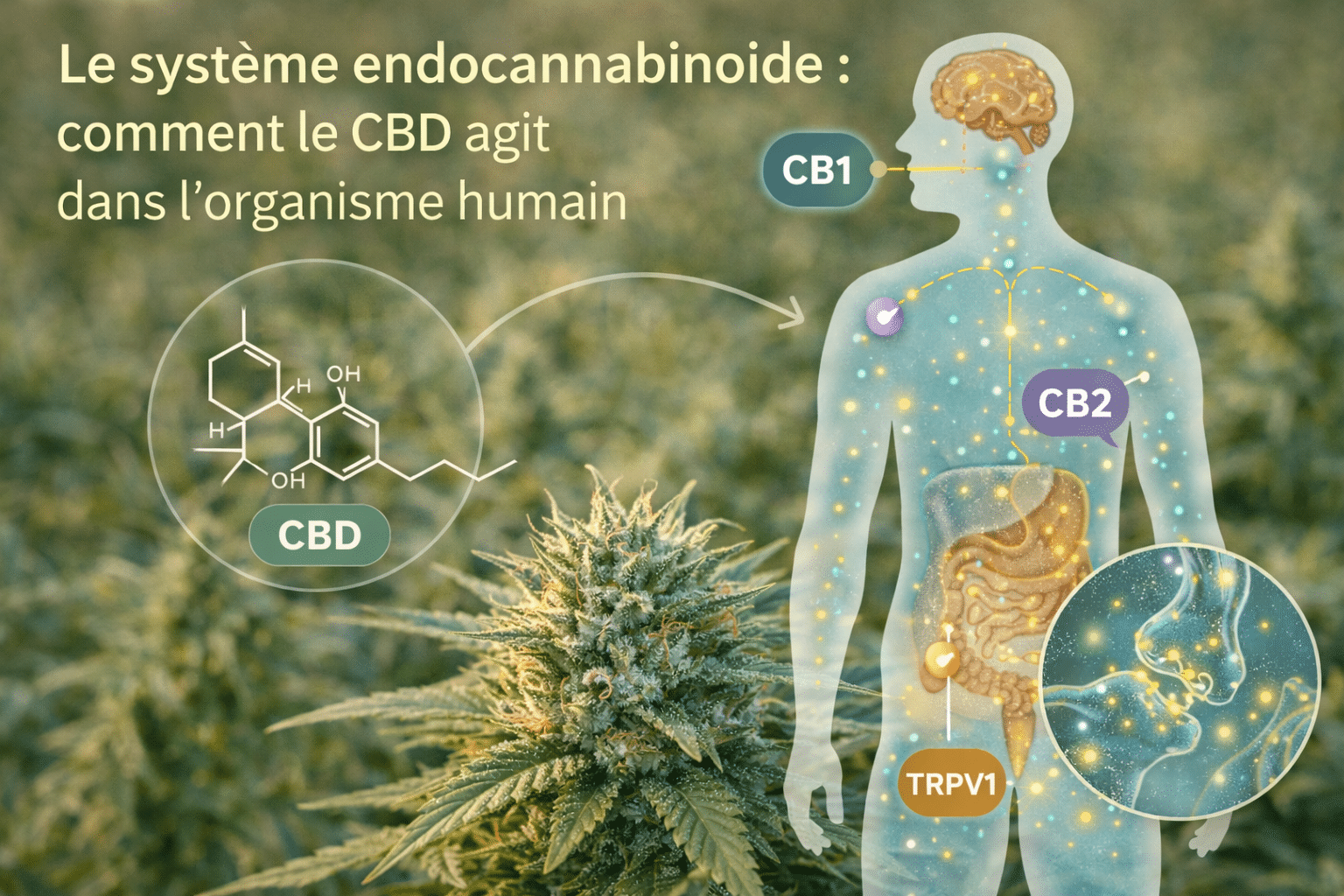
The endocannabinoid system is an essential biological network present in the human body. Relatively recently discovered by science, it plays a fundamental role in regulating numerous physiological functions. This complex system is involved in the body's overall balance, also known as homeostasis, and participates in regulating processes such as sleep, mood, appetite, stress perception, and certain immune responses. Scientific interest in the endocannabinoid system has grown considerably since the identification of cannabinoids present in the hemp plant, notably CBD (cannabidiol) and THC (tetrahydrocannabinol). Understanding how this biological system works allows for a better understanding of how CBD acts in the human body and why this molecule derived from hemp is currently attracting so much attention in the fields of wellness and scientific research.
What is the endocannabinoid system?
The endocannabinoid system, often abbreviated as ECS, is a cell communication system present in all mammals, including humans. It consists of specific receptors, molecules naturally produced by the body called endocannabinoids, and enzymes responsible for synthesizing and breaking down these molecules. This system was identified in the 1990s by researchers studying the mechanisms of action of THC in the human brain. By discovering the receptors to which THC bound, scientists realized that the body already possessed a biological system capable of interacting with similar molecules. This endogenous system plays a central role in regulating physiological balance and is involved in numerous functions of the human body. It acts as a biological adjustment mechanism, maintaining the body in a state of dynamic equilibrium in the face of internal and external variations.
Components of the endocannabinoid system
The endocannabinoid system relies on three main components that work together to ensure its proper functioning. These components are cannabinoid receptors, endocannabinoids naturally produced by the body, and the enzymes responsible for their breakdown. The interaction between these three components allows the system to regulate various essential biological processes.
Cannabinoid receptors
Cannabinoid receptors are proteins located on the surface of certain cells. They act as receptors capable of capturing the chemical signals sent by cannabinoids. The two best-known receptors are the CB1 and CB2 receptors. The CB1 receptor is found primarily in the central nervous system, particularly in the brain, where it plays a role in regulating memory, mood, and sensory perception. The CB2 receptor is more prevalent in the immune system and peripheral tissues, where it participates in modulating inflammatory and immune responses. These receptors play a key role in how cannabinoids interact with the body.
Endocannabinoids
Endocannabinoids are molecules naturally produced by the human body. Unlike cannabinoids from the cannabis plant, called phytocannabinoids, endocannabinoids are synthesized directly by the body when needed. The two main endocannabinoids identified are anandamide and 2-arachidonoylglycerol, often abbreviated as 2-AG. These molecules bind to CB1 and CB2 receptors to transmit chemical signals that regulate various physiological functions. Their production is generally triggered in response to a specific bodily need, allowing for the adjustment of certain biological functions to maintain the body's internal balance.
Metabolic enzymes
Enzymes constitute the third essential element of the endocannabinoid system. They are responsible for the synthesis and degradation of endocannabinoids once these substances have fulfilled their function. For example, the FAAH enzyme is responsible for degrading anandamide after its interaction with cannabinoid receptors. This mechanism helps control the duration of action of endocannabinoids and prevents overstimulation of the system. Enzymes therefore play a crucial role in regulating the activity of the endocannabinoid system.
The role of the endocannabinoid system in homeostasis
One of the most important roles of the endocannabinoid system is to maintain homeostasis, or the body's internal balance. The human body must constantly adapt to environmental and physiological changes to function properly. The endocannabinoid system acts as a biological regulator, adjusting certain functions to maintain this balance. It plays a role in regulating sleep, appetite, mood, stress management, and many other bodily functions. When the body experiences an imbalance, the endocannabinoid system can be activated to restore normal function. This adaptive capacity explains why researchers are increasingly interested in this system in cannabinoid studies.
How CBD interacts with the endocannabinoid system
Unlike THC, CBD does not act directly by binding to CB1 or CB2 receptors. Its interaction with the endocannabinoid system is more subtle and relies primarily on an indirect modulation mechanism. Cannabidiol influences the activity of certain enzymes involved in the breakdown of endocannabinoids. By partially inhibiting the FAAH enzyme, CBD can increase the concentration of anandamide in the body. This increase can enhance the activity of the endocannabinoid system and prolong the effects of the body's natural endocannabinoids. Therefore, CBD acts more as a regulator of the endocannabinoid system than as a direct activator of cannabinoid receptors.
The interaction of CBD with other biological receptors
Scientific research has also shown that CBD can interact with other biological systems besides the endocannabinoid system. For example, cannabidiol can influence certain receptors involved in regulating pain, mood, and the stress response. These receptors include serotonergic receptors, notably the 5-HT1A receptor, which plays a role in mood regulation. CBD can also act on certain receptors involved in transmitting signals related to pain and inflammation. These multiple interactions explain why cannabidiol is generating increasing interest in scientific research.
The endocannabinoid system and scientific research
Since its discovery, the endocannabinoid system has been the subject of extensive scientific research. Researchers continue to explore its role in various biological processes and seek to better understand how cannabinoids from the hemp plant interact with this system. CBD plays a significant role in these studies due to its unique profile and lack of psychoactive effects. Much research is currently focused on how cannabidiol might influence the balance of the endocannabinoid system and contribute to the regulation of certain physiological functions.
Why the endocannabinoid system is essential to understanding CBD
The endocannabinoid system is key to understanding how CBD works in the human body. Without this biological system, the cannabinoids produced by the hemp plant would have no receptors to interact with. The discovery of the endocannabinoid system has profoundly transformed the scientific understanding of cannabis and its natural compounds. It has also opened new avenues for studying the interactions between plant molecules and the human body. Cannabidiol acts as a natural modulator of this complex system, which explains the growing interest in CBD products in the fields of wellness and scientific research.