
-
-
Exhausted
-
Exhausted


What is 10-OH-HHC?
10 -OH-HHC is a cannabinoid derived from HHC, itself resulting from transformations of cannabinoids present in the hemp plant.
To understand this molecule, it is important to remember that the Cannabis sativa L. naturally produces a wide variety of chemical compounds called cannabinoids.
To date, researchers have identified more than 150 different cannabinoids, among which the best known are:
-
CBD (cannabidiol)
-
THC (tetrahydrocannabinol)
-
CBG (cannabigerol)
-
CBC (cannabichromene)
-
CBN (cannabinol)
However, some molecules present in cannabis exist only in very small quantities in the natural plant.
10 -OH-HHC belongs to this category of rare cannabinoids.
This molecule is generally obtained from HHC, a cannabinoid derived from hemp, to which a hydroxyl group (OH) is added during a transformation process.
This chemical modification gives rise to the compound called 10-hydroxy-HHC.
The origin of HHC
To understand 10-OH-HHC, it is helpful to look at the molecule from which it is derived: HHC, or hexahydrocannabinol.
HHC was first identified in the 1940s by American chemist Roger Adams.
This molecule is obtained by hydrogenating THC, a chemical process that alters the structure of the molecule by adding hydrogen atoms.
This transformation alters certain chemical characteristics of the cannabinoid.
10 -OH-HHC is an even more recent molecule, resulting from additional transformations applied to HHC.
These transformations are part of recent advances in cannabinoid chemistry.
The chemical structure of 10-OH-HHC
10 -OH-HHC has a molecular structure similar to that of HHC, but with one important modification: the addition of a hydroxyl group (OH).
In organic chemistry, hydroxyl groups can modify the properties of a molecule.
In the case of cannabinoids, these changes can influence:
-
solubility
-
chemical stability
-
interaction with biological receptors
The chemistry of cannabinoids is particularly complex, and structural variations can alter how these molecules interact with the body.
This is why many derived cannabinoids continue to be studied.
The endocannabinoid system
The cannabinoids present in cannabis interact with a biological network present in the human body called the endocannabinoid system.
This system plays a role in regulating many physiological functions.
It is composed of several elements:
-
CB1 receptors
-
CB2 receptors
-
endocannabinoids produced naturally by the body
-
the enzymes responsible for their metabolism
CB1 receptors are found primarily in the central nervous system.
CB2 receptors are more prevalent in the immune system and certain peripheral tissues.
Cannabinoids derived from hemp can interact with these receptors.
It is this interaction that explains the scientific interest in the different molecules present in the cannabis plant.
Products containing 10-OH-HHC
With the rise of emerging cannabinoids, several types of products containing 10-OH-HHC have appeared on the market.
Enriched flowers
Some hemp flowers may be enriched with distillates containing 10-OH-HHC.
These flowers retain the natural terpenes of hemp while incorporating this cannabinoid.
Resins
Hemp resins can also be enriched with 10-OH-HHC to obtain a more concentrated product.
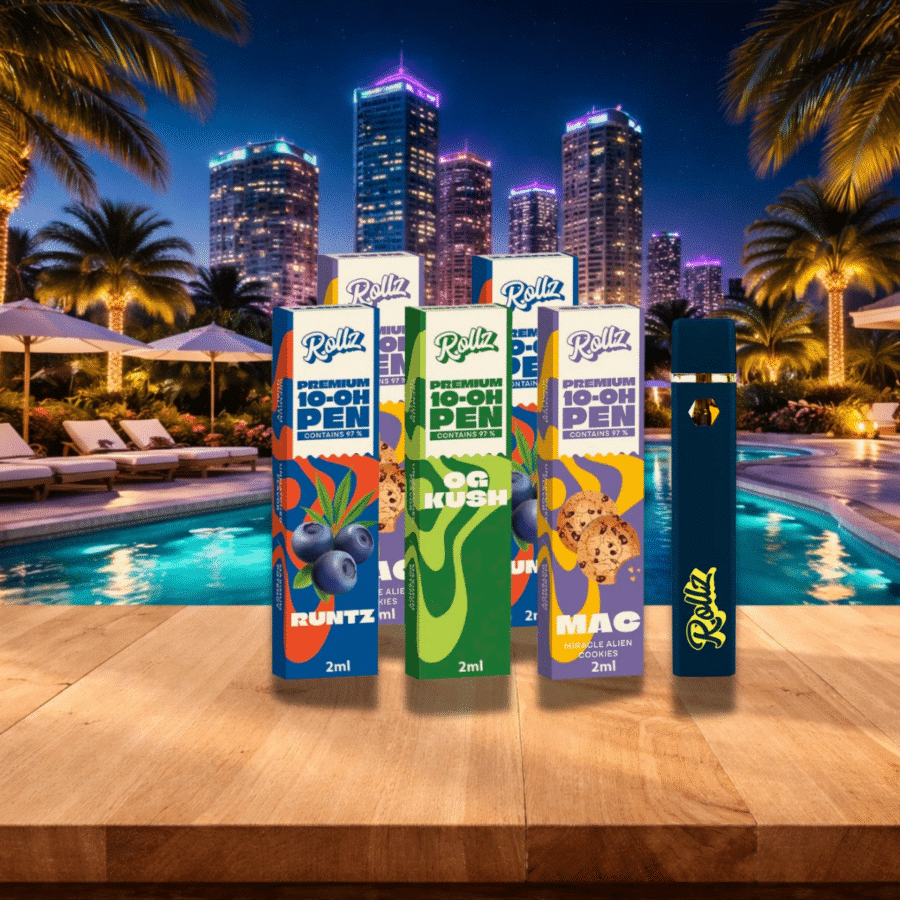
Vapes and cartridges
Vapes and cartridges are currently one of the most popular formats for distilled cannabinoids.
These devices typically contain a distillate mixed with terpenes.
Concentrates
Some products may contain highly concentrated cannabinoid extracts.
These formats are generally intended for experienced users.
Terpenes in 10-OH-HHC products
Terpenes are aromatic molecules naturally present in the cannabis plant.
They are responsible for the characteristic smells and flavors of the different varieties.
In products containing 10-OH-HHC, terpenes can be added to recreate the aromatic profiles of certain popular genetics.
Among the most common terpenes are:
-
myrcene
-
limonene
-
pinene
-
caryophyllene
-
linalool
These molecules contribute significantly to the aromatic richness of the products.
The entourage effect
The entourage effect is an important concept in the study of cannabis.
It describes the synergy between the different compounds present in the plant.
Cannabinoids, terpenes, and flavonoids can interact with each other to produce a more complex experience than that of an isolated molecule.
This is why many products combining modern cannabinoids and terpenes seek to replicate this natural interaction.
The legislation on 10-OH-HHC
Regulations concerning emerging cannabinoids may vary from country to country.
In Europe, hemp-based products must generally meet several criteria:
-
derived from authorized hemp varieties
-
contain less than 0.3% THC
-
comply with national regulations
Certain molecules derived from hemp processing may be subject to regulatory changes.
Players in the legal cannabis market are therefore closely monitoring legislative developments.
Why discover 10-OH-HHC on Vibe City?
Vibe City selects the most innovative cannabinoids from hemp to offer a modern experience around legal cannabis.
Our catalogue includes various products inspired by the latest developments in the cannabinoid industry.
We offer, in particular:
-
flowers enriched with cannabinoids
-
innovative resins
-
vapes and cartridges
-
concentrates derived from hemp
Each product is chosen for:
-
its manufacturing quality
-
its richness in cannabinoids
-
its aromatic profile
-
its compliance with European regulations
Thanks to this selection, Vibe City allows you to discover the new generation cannabinoids that are shaping the current evolution of the hemp market.
FAQ – 10-OH-HHC
What is 10-OH-HHC?
10-OH-HHC is a cannabinoid derived from HHC, obtained through a specific chemical transformation.
Is 10-OH-HHC naturally present in cannabis?
It can exist in very small quantities under certain conditions, but it is usually obtained by transformation of HHC.
Which products contain 10-OH-HHC?
This cannabinoid can be found in enriched flowers, resins, vapes, or concentrates.
Is 10-OH-HHC a recent cannabinoid?
Yes, it is one of the cannabinoids that have recently appeared in the hemp industry.
Where to buy 10-OH-HHC products?
Many consumers choose to buy their cannabinoid products online in order to benefit from a wider selection.


