

CBD may offer modest support for muscle recovery in the 48- to 72-hour window following intense exercise, but no rigorous studies have attributed a direct ergogenic effect to it. Clinical evidence remains limited and is highly dependent on the product's form and quality. For any athlete subject to doping controls, caution is advised due to the risk of cross-contamination with other cannabinoids.
In short:
- CBD may modestly promote muscle recovery by reducing certain biological markers of damage, but does not directly improve performance.
- High bioavailability preparations such as sublingual forms are preferable, with a recommended dose of approximately 60 mg after exercise.
- Product quality and traceability are crucial to avoid contamination and the risk of a positive test in competition.
- Pure CBD is not banned by the World Anti-Doping Agency, but contaminated or broad-spectrum products may contain detectable cannabinoids in analyses.
- Optimal recovery remains primarily based on sleep, hydration and a suitable diet, with CBD being a supplementary aid.
Table of Contents
- What does the clinical evidence say about CBD and sports recovery?
- How does CBD affect inflammation and muscle pain?
- Which form of CBD should I choose for recovery after exercise?
- Does CBD present any risks or interactions that should be known?
- Is CBD allowed in sports competitions?
- How to integrate CBD into a recovery routine without making mistakes?
- Vibecity's evidence and commitments regarding CBD quality
- Is CBD better than other methods of sports recovery?
- What do athletes who use CBD report after training?
- Is CBD legal for athletes in France and Europe?
- Practical perspective: what are the realistic expectations for an athlete?
- Where can I find a reliable CBD product to support my recovery?
- Sources
- Frequently Asked Questions
What does the clinical evidence say about CBD and sports recovery?
Randomized trials published between 2021 and 2024 paint a more nuanced picture. Contrary to what some advertisements suggest, CBD does not make you run faster or lift heavier. What it does, potentially, is mitigate certain biological signals of muscle stress once the effort is over.
A crossover trial conducted by Isenmann and colleagues demonstrated a reduction in circulating myoglobin and improved recovery of squat strength, measured 72 hours after intensive resistance training. Other systematic reviews indexed on PMC confirm this trend: a decrease in muscle damage markers (creatine kinase, myoglobin) and a reduction in delayed onset muscle soreness (DOMS), but concentrated within this two- to three-day window.
What the biomarkers reveal: the observed reduction in CK and myoglobin remains modest, on the order of a few tens of percent depending on the protocols, and it does not systematically translate into a measurable performance gain by stopwatch or on the loads lifted.
Three limitations recur in the literature:
- Trial numbers are small, often less than thirty participants per arm.
- The tested preparations vary enormously in concentration, spectrum and bioavailability, which makes comparisons difficult.
- The majority of studies focus on one-off eccentric efforts, not on prolonged training cycles.
In short, CBD acts as a modest recovery accelerator on specific biological markers, without guaranteeing a general feeling of freshness or faster progress. It's a real signal, but it should be taken for what it is: a supplementary effect, not a shortcut.
How does CBD affect inflammation and muscle pain?
The proposed mechanism relies on the interaction of cannabidiol with the endocannabinoid system, a network of receptors that regulates, among other things, pain perception and the inflammatory response. In vitro studies suggest that CBD modulates inflammatory pathways such as NF-κB and JAK/STAT, which could inhibit the production of pro-inflammatory cytokines after traumatic exertion on muscle fibers.
A second, more indirect but equally important mechanism for athletes involves sleep. A narrative review published in Sports Medicine Open notes that CBD has modest anxiolytic properties that promote faster sleep onset in some users. Deep sleep remains the primary physiological driver of recovery, far more so than any supplement.
- Possible reduction of post-exercise inflammatory cytokines.
- Mild anxiolytic effect promoting sleep quality.
- Modulation of pain perception via CB1/CB2 receptors.
Pro tip: Don't try to eliminate all inflammation after a session. Controlled inflammation is part of the signal that triggers muscle adaptation; the goal of CBD is to reduce excess, not to cancel the process.
Excessive anti-inflammatory modulation could, in theory, attenuate the signals that trigger muscle supercompensation. No study has yet quantified this risk in humans, but it justifies targeted use rather than systematic intake after each workout.
Which form of CBD should I choose for recovery after exercise?
The method of administration makes almost everything. Trials showing a measurable effect almost always use sublingual preparations or highly bioavailable solubilizers, never simple standard oils absorbed via the conventional digestive tract. Topical applications, on the other hand, regularly disappoint: a review presented at the 2023 ACAPS congress reports that high doses of topically applied CBD did not alter pain thresholds or strength in several controlled trials. The skin significantly limits the penetration of the active ingredient.
Here is a step-by-step approach to incorporating CBD without choosing the wrong form:
- Prefer sublingual or solubilized form rather than classic oil or topical application, to maximize absorption.
- Refer to the dosages studied, around 60 mg taken after exercise in several research protocols, without exceeding this range without medical advice.
- Test the timing of post-workout rather than taking it preventively before exercise, the goal being to support the recovery phase, not the performance itself.
- Start with a low dose and gradually increase it over several sessions to observe your own tolerance.
- Document each intake in a simple notebook: dose, time, how you felt the next day.
For a competitor, certified isolate remains the most prudent choice; this point will be detailed in the section dedicated to anti-doping.
Does CBD present any risks or interactions that should be known?
The short-term safety profile of CBD is generally reassuring. A recent systematic review published on PMC reported no serious adverse effects in the trials analyzed, only minor inconveniences such as dry mouth or mild drowsiness in some users.
The point that really deserves your attention concerns drug interactions. CBD is metabolized by cytochrome P450 enzymes, the same family involved in the metabolism of many common medications.
- Anticoagulants: risk of interaction, medical monitoring recommended.
- Anticonvulsants: dose adjustments sometimes necessary under supervision.
- Sleeping pills or anxiolytics: potentially cumulative sedative effect.
Pro tip: If you are taking any regular medication, talk to your doctor or pharmacist before introducing CBD, even for occasional use.
In practice, keep a diary of your intake, reduce the dose at the slightest sign of excessive drowsiness, and stop taking it several days before a competition if you have any doubt about the exact composition of the product.
Is CBD allowed in sports competitions?
The rule is simple on paper, but more complex in practice. The World Anti-Doping Agency's 2026 list of prohibited substances explicitly excludes cannabidiol (CBD) from section S8, which deals with cannabinoids. In practical terms, pure CBD is not a prohibited substance during competition. All other natural and synthetic cannabinoids, however, remain prohibited during competition periods, with a specific urinary threshold set for THC.
The problem doesn't stem from the CBD molecule itself, but from what else is in the bottle. An analytical study of commercial CBD products detected minor cannabinoids like CBG at levels up to 800 ng/mL in the urine of volunteers, with 53% of them still testing positive for CBG eight hours after ingestion. These trace amounts are, in theory, enough to trigger an abnormal test result.
- Always choose a CBD isolate, not a broad or full spectrum product.
- Require a batch-by-batch Certificate of Analysis (COA), not a generic certificate from the manufacturer.
- Avoid taking any product in the days leading up to a competition unless you are completely certain about its composition.
As recalled in studies published on PMC concerning the risks of cross-contamination, the responsibility for a positive result falls entirely on the athlete, regardless of the labeling of the product consumed.
How to integrate CBD into a recovery routine without making mistakes?
First and foremost, check three things: the absence of any incompatible current treatments, the absence of any close competition if you are being tested, and your general tolerance to supplements. Once these boxes are checked, a simple trial protocol allows for an objective assessment of whether CBD is beneficial for you.
- Week 1 : Choose a batch-certified isolate with COA, start at a low dose (around 20 mg) taken after training.
- Week 2 : Gradually increase up to 40 mg if no excessive sleepiness occurs, noting your DOMS level each night on a simple scale of 1 to 10.
- Week 3 : stabilize around 60 mg if tolerance is good, while simultaneously monitoring the quality of your sleep and your feeling of general fatigue upon waking.
Pro tip: If you have access to blood tests, spot monitoring of CK and myoglobin markers before and after an intense session provides a much more reliable objective measurement than subjective feeling alone.
Stop or adjust the dose if you experience bothersome drowsiness, decreased motivation to train, or no noticeable effect after three weeks. A gradual testing protocol documented in a recent systematic review follows this exact logic of step-up.
Vibecity's evidence and commitments regarding CBD quality
A poorly controlled CBD product can ruin a sports season, even without malicious intent on the part of the athlete. Vibecity bases its selection on traceability and compliance, two criteria that matter more than price to an athlete subject to testing.
The recommendation remains consistent for competitors: prioritize certified isolates with batch-by-batch analysis certificates rather than broad-spectrum formulas, whose composition of minor cannabinoids varies from batch to batch. Online customer service allows you to obtain these documents before purchase, thus avoiding unpleasant surprises once the product has already been opened.
Is CBD better than other methods of sports recovery?
Compared to traditional recovery strategies, CBD plays a supporting role, not a primary one. Sleep, hydration, post-exercise nutrition, and active stretching remain the pillars whose long-term effectiveness is best established. CBD is positioned more as a complement to these foundations, comparable to other supplements such as caffeine for alertness or collagen for joint and tendon support.
| Method | Targeted benefit | Speed of action | Level of evidence |
|---|---|---|---|
| Optimized sleep | Overall, hormonal recovery | Cumulative effect over several nights | Pupil |
| CBD sublingual/solubilizate | Pain, mild inflammation, sleep | 48 to 72 hours for muscle markers | Moderate, limited studies |
| Cryotherapy/cold baths | Reduction of local edema | Immediate but temporary | Moderate, debate on adaptation |
| Collagen + Vitamin C | Tendon and joint support | Effect lasting several weeks | Moderate to high according to studies |
The major difference from most conventional supplements is the botanical guide to restorative sleep, which reminds us of an often-forgotten fact: improving sleep quality produces a broader restorative effect than any cannabinoid taken in isolation. CBD works better as part of a routine than as a standalone solution.
What do athletes who use CBD report after training?
The experiences shared by amateur and semi-professional athletes often converge on the same qualitative observations: a reduced feeling of muscle tension the day after an intense workout, and a perceived faster onset of sleep on the evenings when taking the product. These accounts remain subjective and do not replace data from controlled trials, but they correlate fairly well with the results measured on biological markers in clinical studies.
Some athletes who participate in high-impact sports, such as trail running or CrossFit, report a greater benefit in managing general muscle soreness than in addressing the localized pain of a specific injury. Others, particularly those involved in strength sports, notice little perceptible difference as long as they don't exceed particularly eccentric training sessions.
One point consistently emerges in these informal accounts: the perceived effect depends heavily on the product used, its actual concentration, and the regularity of intake. Users who have switched brands or forms often report different results with the same nominal dose, confirming the clinical observations on the importance of bioavailability mentioned earlier. These individual impressions do not constitute scientific proof, but they clearly illustrate why the quality and consistency of the product matter as much as the dose indicated on the label.

Is CBD legal for athletes in France and Europe?
In France, as in the rest of the European Union, the sale and consumption of CBD extracted from legal hemp are permitted as long as the THC level complies with current regulatory limits. This general legality is distinct from the specific rules governing competitive sports, which fall under the jurisdiction of a different authority.
For a licensed athlete subject to doping controls, the World Anti-Doping Agency's list of prohibited substances applies, not civil legislation regarding hemp. CBD is explicitly excluded from this list, unlike THC and other psychoactive cannabinoids, which remain prohibited in competition. An unlicensed amateur athlete, on the other hand, is not subject to any of these anti-doping restrictions and is governed solely by the civil legal framework applicable in their country.
This distinction between civil legality and sporting conformity explains why a product that is perfectly legal to buy can nevertheless expose a competitor to a risk of a positive test, if its composition contains traces of cannabinoids not declared on the label.
Practical perspective: what are the realistic expectations for an athlete?
CBD won't make you a better athlete. At best, it can make the 48 hours following a tough workout a little more bearable, provided you choose the right form and dose. The real factor determining whether the experience is worthwhile isn't the CBD itself, but the care with which you choose your product.
For a competitor, quality control is more important than the desired effect: a poorly certified product can cost you an entire season. Pay attention to upcoming publications rather than marketing claims, and never make it an automatic reflex after every session.
— Julien
Where can I find a reliable CBD product to support my recovery?
Faced with the issue of bioavailability and quality control discussed throughout this article, Vibecity offers a concrete alternative to the poorly documented formulas circulating on the market: a selection of traceable products, with traceability and compliance verifiable before purchase, rather than a simple marketing promise on the label.
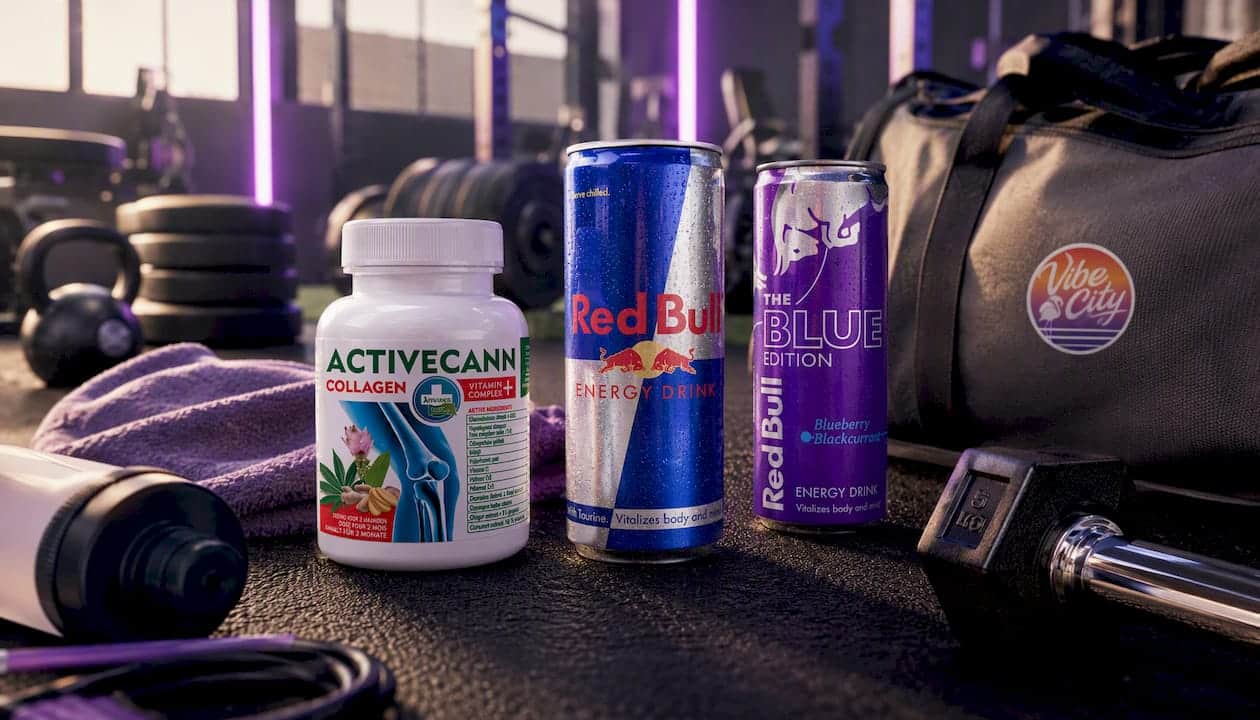
Among the products in the catalog, Activecann Collagen combines joint support and cannabidiol in a formula designed for athletes seeking a targeted supplement rather than a generic oil. For competitors concerned about doping risks, the best course of action is to contact customer service to obtain the batch analysis certificate before placing any order. The store also carries other everyday products, including drinks like Red Bull or the blueberry-blackcurrant version , to complement a broader recovery routine. Consult the Activecann Collagen product page to verify the exact composition before ordering.
This article provides general information and is not a substitute for professional medical advice. Consult a qualified healthcare professional about your specific situation before taking any action based on this content.
Sources
- WADA Prohibited List 2026 (final)
- Systematic reviews / trials on CBD and recovery (PMC)
- Effects of Cannabidiol Supplementation on Skeletal Muscle Regeneration after Intensive Resistance Training (MDPI, 2021)
Frequently Asked Questions
Does CBD really improve muscle recovery?
It can modestly reduce certain markers of muscle damage and soreness 48 or 72 hours after exertion, without a direct effect on performance itself.
Is CBD prohibited in sports competitions?
No, pure CBD is explicitly excluded from the World Anti-Doping Agency's list of prohibited substances, unlike other cannabinoids such as THC.
What is the risk of contamination with a commercially available CBD product?
Some broad-spectrum products contain traces of minor cannabinoids like CBG, detectable in urine, which can trigger an abnormal test result in an athlete being tested.
Where can I find a certified CBD product suitable for athletes?
Vibecity offers products selected for their traceability, such as Activecann Collagen, and recommends systematically requesting a batch-by-batch certificate of analysis before any use in competition.


