

For the sale of hemp-derived products, the regulatory benchmark is set at a specific THC threshold. For driving, however, French law applies a zero-tolerance policy: the mere detection of THC in the body is sufficient to constitute an offense, regardless of the measured concentration. These two thresholds operate according to distinct principles and should never be confused. Before making any purchase, check the Certificate of Analysis (CoA) for the batch in question.
In short:
- The French regulatory threshold for THC in hemp products is set at 0.30%, measured on dry matter, but does not apply during processing or in concentrated finished products.
- The law considers any presence of THC during a roadside check as an offense, without concentration limit, and severely punishes driving after consumption.
- Verifying an accurate certificate of analysis, stating the total THC level and the method of analysis, is essential before any purchase.
- Exceeding the 0.30% threshold makes a product classified as a narcotic, with heavy criminal and administrative penalties, including seizure or withdrawal from sale.
- Recent case law permits the sale of compliant CBD flowers and leaves, but requires constant vigilance regarding the traceability and conformity of batches.
Table of Contents
- What legal framework governs THC levels in France?
- How is the regulatory threshold applied depending on the product?
- What are the risks of being stopped by the police after consuming CBD?
- What has changed with the Council of State's decision on CBD?
- How to read a reliable Certificate of Analysis (CoA)?
- What are the penalties for exceeding the legal limit?
- How does Vibecity control the compliance of its CBD products?
- Things to remember before buying or driving
- Compliant CBD resins and infusions, ready to order
- Sources
- Frequently Asked Questions
What legal framework governs THC levels in France?
The legal THC limit applicable to commercial products is based on a specific text: thedecree of December 30, 2021, published in the Official Journal, which sets the limit at 0.30% delta-9-THC for hemp varieties listed in the European catalogue and their extracts. This text replaced a previous, lower threshold, raised to align France with European agricultural standards.
This threshold coexists with two other legal frameworks that should not be confused.
- The Public Health Code classifies cannabis as a narcotic as soon as its THC content exceeds this regulatory threshold, which then moves the product out of the legal scope of industrial hemp.
- The Highway Code, via its article L235-1, does not set any authorized threshold for driving: the presence of THC detected by a test is sufficient to characterize the offence, regardless of the quantity found.
Three texts, three logics: agricultural and commercial on one side, criminal on the other, and a zero tolerance for road safety which totally ignores the regulatory threshold.
How is the regulatory threshold applied depending on the product?
The regulatory threshold is not applied in the same way depending on what you buy. Originally, it concerned hemp varieties listed in the official European catalogue, measured on the dry matter of the plant harvested in the field. It is primarily an agronomic benchmark, designed to distinguish industrial hemp from cannabis for recreational use.
The problem arises during processing. An extract, oil, or e-liquid concentrates the cannabinoids present in the original plant, which can artificially inflate the concentration measured in the finished product compared to the initial concentration in the raw material. Conversely, dilution in a food base can cause it to drop significantly.
Several situations remain sources of dispute:
- Raw flowers and buds, sold as is, have been in a grey area since the partial annulment of the general ban by the Council of State.
- Food products containing CBD also fall under the European regulation on novel foods, several dossiers of which are still under evaluation by the EFSA.
- Resins and hash, being more concentrated by nature, require systematic verification of the actual level before being placed on the market.
What are the risks of being stopped by the police after consuming CBD?
The most common misconception concerns driving. Unlike alcohol, which has a precise legal limit (0.5 grams per liter of blood), THC has no tolerance margin in France. Article L235-1 of the French Highway Code punishes driving after using narcotics as soon as their presence is established, without reference to a minimum quantity.
In practice, the control takes place in two stages.
- A pre-screening saliva test is carried out on the side of the road; it detects the presence of THC qualitatively, without precisely measuring the concentration.
- In the event of a positive result, a blood test confirms the result in the laboratory, where technical detection thresholds apply according to the analytical method used, but these thresholds only serve to validate the reliability of the test, not to define a legal limit for consumption.
For regular CBD users, this point warrants serious attention: some poorly controlled products contain traces of THC sufficient to trigger a positive test several hours, or even several days, after ingestion. Avoiding driving after recent use remains the only reliable precaution.
What has changed with the Council of State's decision on CBD?
In December 2022, the Council of State overturned the general ban on the sale of cannabis flowers and leaves lacking narcotic properties. The highest court deemed the measure disproportionate, given that CBD has no proven psychotropic effect.
This decision has concrete, but partial, consequences.
- It restores the legal possibility of selling CBD flowers and leaves that comply with the regulatory threshold, where the general ban targeted them indiscriminately.
- However, this does not create a stable framework: local uncertainties persist, with some municipalities or prefectures continuing to adopt their own restrictive decrees.
- For traders, it does not in any way exempt them from rigorously verifying the actual level of each batch, which remains the only effective protection against reclassification as narcotics.
How to read a reliable Certificate of Analysis (CoA)?
A certificate of analysis is more than just a single number. The distinction between total THC and free THC is crucial: THCA, the acidic form naturally present in the plant, is converted into active THC through decaboxylation, generally under the influence of heat. The analytical method and sample preparation therefore directly affect the final result; a batch may show a compliant level when cold but exceed the limit once heated.
The reference analytical method remains chromatography, described in the annex to the decree of December 30, 2021, ideally carried out by a laboratory accredited according to the ISO 17025 standard.
Pro tip: Before making any purchase, always ask for the Certificate of Analysis (CoA) for the specific batch you intend to buy, not a generic document for the entire range. Check four things: the date of issue, the batch number that corresponds exactly to the product, the analytical method used, and the total THC level as distinguished from THCA.
- Recent date of analysis, ideally linked to the commercially available batch and not to a generic sample.
- Batch number that corresponds precisely to the physical product in your possession.
- Explicit mention of the method (chromatography) and the accredited laboratory that carried out the test.
What are the penalties for exceeding the legal limit?
Exceeding a regulatory threshold of THC causes a product to fall into the category of narcotics under the Public Health Code, with serious criminal consequences for possession, transport or sale, regardless of the seller's intention.
The risks are not solely criminal.
- On the administrative level, a non-compliant batch may be subject to seizure, withdrawal from sale or an official recall via the Recall, held by the DGCCRF.
- From a commercial perspective, a company found to have non-compliant products risks a lasting loss of trust with its customers, in addition to administrative penalties.
- Health authorities also remind us that a commercially legal product is not synonymous with total safety, which prohibits any unproven therapeutic claim on the packaging or in communication.
Documented traceability of each batch, from producer to end consumer, remains the best guarantee against these cumulative risks.
How does Vibecity control the compliance of its CBD products?
Faced with this shifting landscape, rigorous product selection becomes the only viable solution. Vibecity applies a deliberately restrictive approach: rather than multiplying its product range, the retailer prioritizes products whose origin, variety, and extraction method are documented.
A compliant batch is never just a marketing claim. Three elements must always accompany a genuine product:
- A recent certificate of analysis, issued by an ISO 17025 accredited laboratory, stating the total THC level measured on the specific batch.
- An identified varietal origin, consistent with the cultivars listed in the authorized European catalogue.
- A clearly indicated extraction method, on which the final cannabinoid concentration directly depends.
Reference point: the French regulatory threshold of 0.30% THC remains the sole reference to request on any compliance document, regardless of the type of product purchased.
Things to remember before buying or driving
Always check the Certificate of Authenticity (CoA) of a batch before buying, never drive after recently consuming a product if you have any doubts, and always keep your proof of purchase. For products that are controlled at every stage, it is important to consult a reliable source.
— Julien
Compliant CBD resins and infusions, ready to order
Finding a product with a precisely documented THC content remains the real challenge for French consumers, far more so than understanding the law itself. Some retailers' catalogs are built around this requirement, featuring products whose traceability can be verified before purchase.
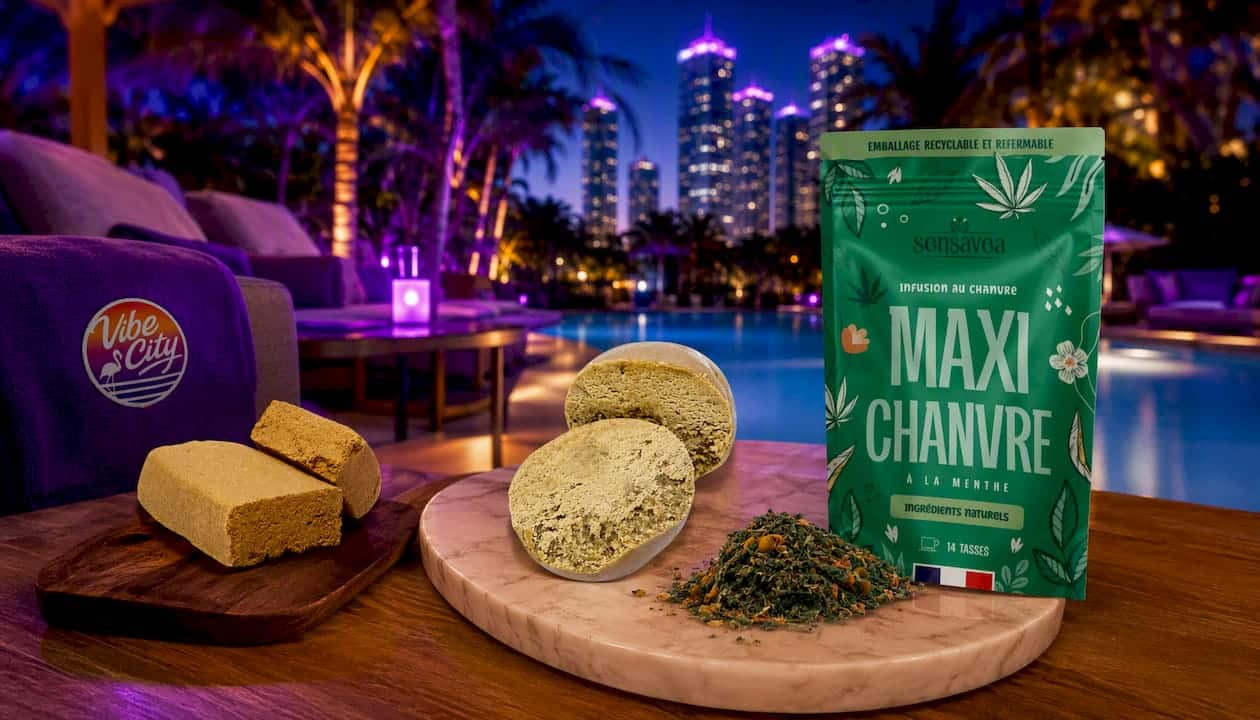
Static BZ10 Resin appeals to those who enjoy dense textures and pronounced flavor profiles, with systematic compliance checks before being offered for sale. Yellow Cream CBD Resin offers a milder alternative, appreciated for its distinctive aroma. For those who prefer to avoid combustion, Sensavea's Maxi Hemp CBD Infusion and Herbal Tea, certified 100% organic, offers a smoke-free daily option.
Each product can be ordered with a certificate of analysis, and delivery is sometimes free depending on the seller's terms. Consult the complete catalog on Vibecity to compare profiles and place your order with full knowledge of the facts.
Sources
- Official Journal – Decree of December 30, 2021
- Council of State – annulment of the decree on cannabis flowers and leaves (Dec. 2022)
- Official Journal – No. 304 of 31 December 2021 (analytical method annex)
- MILDECA – CBD
Frequently Asked Questions
What is the current legal THC limit in France?
The regulatory threshold remains set at 0.3% delta-9-THC for hemp-derived products, in accordance with the decree of December 30, 2021, which is still in force.
What THC level is considered acceptable for a CBD product?
A product is compliant when its delta-9-THC content does not exceed 0.3%, measured using the chromatographic method described in the annex to the official text. This figure must always be verified via the certificate of analysis for the batch in question, and not deduced from the mere commercial presentation.
Is 5 mg of THC a significant amount?
The effect felt depends on individual tolerance and method of consumption, but this issue does not concern the French legal framework: no level of THC consumed is authorized for driving, regardless of the dose ingested.
Is there a THC level that produces psychoactive effects?
The regulatory threshold defined by French law is a regulatory benchmark for marketing, not a limit of psychoactive effect: beyond this content, the product legally falls into the category of narcotics, regardless of the intensity of the effect felt by each person.


