

There is no universal time: the choice depends on the desired effect, the form consumed, and the dosage. Mornings are suitable for calm alertness and managing daytime stress, while evenings promote muscle relaxation and sleep. Some people even benefit from splitting their intake between the two times.
In short:
- Taking CBD in the morning targets calm alertness and stress reduction, with low to moderate doses to avoid drowsiness.
- CBD in the evening promotes muscle relaxation and sleep, with higher doses of 25 to 50 mg generally recommended.
- The onset of action varies depending on the method of administration, ranging from 1 minute by inhalation to 60 minutes by oral administration, with a biphasic effect depending on the dose.
- Adapting the intake to the chronotype and the objective promotes effectiveness, taking into account possible interactions with other treatments.
- The routine must be accompanied by precise monitoring, avoiding errors in dosage or timing, to optimize the benefits of CBD according to the time of day.
Table of Contents
- Why take CBD in the morning: benefits and target groups
- Why take CBD in the evening: relaxation, sleep and recovery
- Dosage, onset of action and biphasic effect: practical rules
- Choose morning or evening depending on your goal: grid and concrete examples
- Practical ritual and adaptation according to chronotype
- About the author and Vibecity
- Editorial perspective: experiment rather than follow an absolute rule
- A simple routine to start with: Sensavea infusions
- Sources
- Frequently Asked Questions
Why take CBD in the morning: benefits and target groups
Taking CBD in the morning has a specific goal: to maintain alertness while easing the nervous tension of waking up. At low doses, the molecule acts more on anxiety than on drowsiness, making it compatible with a workday or a workout.
Certain profiles particularly benefit from this approach:
- People under intense cognitive stress (meetings, exams, deadlines) seek a calming alertness rather than a sedative effect.
- Athletes sometimes use a microdose before exercise to calm apprehension without losing reactivity.
- People prone to morning anxiety find in a light dose a way to start the day without agitation.
Dosage guidelines for a daytime effect are generally low to moderate, in the form of sublingual oil or infusion, which are easier to dose precisely than a slow-release capsule. Excessive doses may cause drowsiness, so caution is advised before driving or performing tasks requiring concentration.
Why take CBD in the evening: relaxation, sleep and recovery
In the evening, the objective changes. The goal is no longer calm alertness but complete relaxation, both mental and muscular, that prepares the body for sleep. CBD has its most documented role in this process, particularly for people who have difficulty falling asleep or who suffer from nighttime pain.
Several situations justify taking this medication in the evening:
- Sleep-onset insomnia, where the mind remains active despite physical fatigue.
- Chronic or inflammatory pain that intensifies at night, in the absence of daytime distraction.
- Sports recovery, when muscle tension accumulated during the day delays falling asleep.
The recommended doses then increase to between 25 and 50 mg, preferably sublingually or as an oil, sometimes combined with CBN or melatonin to support sleep continuity—a combination that some practical protocols recommend as a supplement, but this does not replace medical advice if you are currently undergoing treatment. The Dietetical tutorial on CBD and sleep recommends taking it 30 to 60 minutes before bedtime, to allow the molecule time to reach its active concentration.
Pro tip: Turn off your screens while taking your evening CBD. This action becomes a signal to the body, almost more effective than the molecule itself.

Dosage, onset of action and biphasic effect: practical rules
The time to action varies greatly depending on the route of administration, and ignoring this variable leads to underdosing or overdosing without realizing it.
| Administrative route | Estimated time to act | Approximate duration of effect |
|---|---|---|
| Inhalation (vaping) | 1 to 5 minutes | 2 to 4 hours |
| Sublingual (oil) | 15 minutes | 4 to 6 hours |
| Oral (infusion, capsule) | 60 minutes | 6 hours |
| Topical (local balm) | Variable, localized effect | 3 to 5 hours |
These figures come from a pharmacokinetic review published on PubMed, but individual sensitivity remains wide: weight, metabolism and consumption habits vary these ranges.
CBD has a biphasic effect that depends on the dose : a small amount tends to stimulate alertness, while a higher dose promotes relaxation and sleep. This shift explains why the same oil can be suitable for both morning and evening use, provided the quantity is adjusted.
To find your own threshold, a gradual method works better than a fixed dosage copied from a leaflet:
- Start with a low dose (5 to 10 mg) for one week, at the target time.
- Increase in increments of 5 mg every 3 to 4 days if the effect remains insufficient.
- Record each catch, the time and the sensation felt in an observation log.
- Stabilize the dose as soon as the desired effect appears without excessive drowsiness or relaxation.
Choose morning or evening depending on your goal: grid and concrete examples
The right approach is to start with the objective, not the time. A simple grid helps to make a quick decision:
- Daily stress and alertness → morning intake, low dose, oil or light infusion.
- Sports performance or preparation → microdose before exercise, sublingual form for a rapid effect.
- Sleep-onset insomnia → take in the evening, higher dose, 30 to 60 minutes before bedtime.
- Persistent chronic pain → divided dose, morning and evening, to maintain a constant level.
Before adjusting your routine, ask yourself a few simple questions:
- Are you taking any medication that could interact with CBD?
- Are you more of a morning person or a night owl in your natural rhythm?
- Have you ever tried CBD, and at what dose does your tolerance seem to be?
Splitting the dose, with two small doses spread throughout the day, is particularly suitable for pain that persists from morning to night, where a single dose would leave hours without coverage.
Practical ritual and adaptation according to chronotype
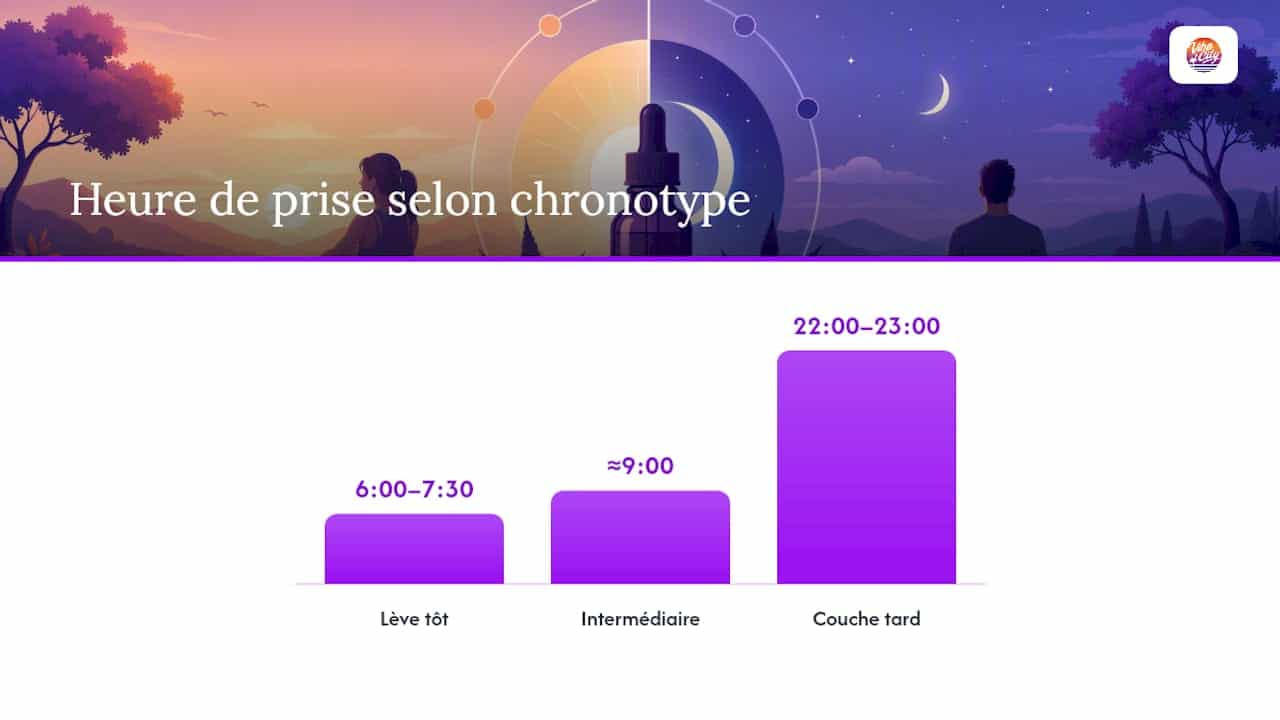
Chronotype directly influences the best time to take CBD. A simple ritual, repeated every day at the same time, reinforces the perceived effect of CBD, almost like a conditioned reflex.
- Early riser : morning intake between 6am and 7:30am, before the peak of cognitive activity.
- Intermediate chronotype : microdose around 9 a.m., then possible second dose in the late afternoon if stress returns.
- Late night : evening intake shifted between 10 p.m. and 11 p.m., consistent with a later bedtime.
Associate taking the medication with an already established habit: morning coffee, evening herbal tea, brushing your teeth. This association makes the routine easier to maintain over time.
Pro tip: Keep a log for 2 to 4 weeks before judging the effectiveness of a timing plan. A single trial is never enough to assess an individual response.
About the author and Vibecity
This article is by Julien, a writer specializing in cannabidiol and wellness. A specialized shop selects its products based on traceability and compliance rather than simply offering a wide range of varieties. Sensavea infusions exemplify this approach: one version is ideal for a gentle morning dose, while another naturally fits into an evening ritual. It's best to start small and observe your own reaction.
Editorial perspective: experiment rather than follow an absolute rule
The answer to "morning or evening" is entirely up to you. Dosage guidelines and onset of action provide a framework, not a universal prescription. Honestly track how you feel, and consult a healthcare professional if you are taking other medications. The quality of the product is just as important as the timing: a poorly sourced oil will ruin any attempt at proper adjustments.
— Julien
A simple routine to start with: Sensavea infusions
Rather than experimenting with complex, dosage-sensitive forms, an infusion remains one of the simplest ways to incorporate CBD into a daily routine. Vibecity offers two varieties designed for different times of day.

Sensavea's Maxi Hemp CBD Infusion, 100% organic, is suitable for morning or daytime use, complementing a calming routine without a pronounced sedative effect. Sensavea's Anti-Stress CBD Infusion, also 100% organic, is designed for evening relaxation and should be incorporated into your end-of-day ritual 30 to 60 minutes before bedtime. Both products adhere to strict traceability and compliance standards.
Sources
The recommendations in this article are based on a review published on NCBI concerning CBD, anxiety and sleep, a pharmacokinetic synthesis referenced on PubMed, as well as the official information flyer on CBD published by the interministerial mission to combat drugs.
This article provides general information and is not a substitute for professional medical advice. Consult a qualified healthcare professional about your specific situation before taking any action based on this content.
- Cannabidiol in Anxiety and Sleep: A Review of the Current Evidence
- Pharmacokinetics of cannabidiol in humans: A systematic review
Frequently Asked Questions
When is the best time to take CBD?
There is no universally suitable time: the morning is appropriate for calm alertness and low doses, while the evening promotes relaxation and sleepiness at higher doses. The choice depends primarily on your goal and individual sensitivity.
Which CBD is best for tendonitis?
For localized pain such as tendonitis, a topical balm applied directly to the area offers a targeted effect, possibly supplemented by oral intake in the evening to support nighttime recovery. Dosage adjustments should be gradual, as with all CBD use.
Is CBD good for sciatica?
Some people report partial relief from sciatica pain by taking the medication in the evening, as it promotes muscle relaxation and improves sleep quality. However, this is not a substitute for medical advice, especially in cases of persistent pain or if you are currently undergoing treatment.
Which CBD is best for chemo?
Patients undergoing chemotherapy must consult their medical team before using CBD, due to the risk of interactions with certain treatments. The official CBD leaflet reiterates this need for caution in the context of concurrent treatments.


